FPGA vs GPU in High-Performance Computing
This FPGA vs GPU interview examines how the two architectures differ in high-performance computing. Comparing a Field Programmable Gate Array (FPGA) vs a Graphics Processing Unit (GPU) is especially relevant for workloads that depend on low latency, sustained bandwidth, deterministic processing, and custom dataflow. It also explores why FPGAs are gaining renewed attention as system designers look for alternatives and complements to GPU-centric architectures.
FPGA vs GPU Interview – Key Insights from the Conference
During the session, Mr. Weintraub emphasized that the traditional view of FPGAs as “hard to program” is rapidly changing. With improved toolchains, modular IP libraries, and higher-level development frameworks, FPGAs are becoming far more accessible. This shift allows developers to target workloads that benefit from FPGA architectures. Key advantages can include deterministic latency, custom dataflow, and direct high-bandwidth I/O.
One major topic discussed was memory bandwidth. GPUs achieve high throughput, but they are often limited by fixed memory hierarchies. FPGAs, on the other hand, allow developers to build data pipelines tailored to the exact processing flow. As a result, FPGA pipelines can reduce unnecessary data movement and lower latency. They can also handle workloads that benefit from customized dataflow.
Where FPGAs Can Outperform GPUs
| Area | FPGA | GPU |
|---|---|---|
| Processing Model | Custom hardware pipelines and dataflow | Programmable massively parallel compute |
| Latency | Highly deterministic and predictable | Typically more dependent on scheduling and shared resources |
| Streaming Workloads | Strong fit for continuous pipelined processing | Strong for massively parallel and batched processing |
| I/O Integration | Direct and customizable high-bandwidth interfaces | Typically uses fixed host, memory, and peripheral interfaces |
| Parallelism | Fine-grained and workload-specific | Massive general-purpose parallelism |
| AI Inference | Efficient for selected and highly optimized workloads | Very strong for broad AI frameworks and model execution |
| Image Preprocessing | Well suited to deterministic inline image processing | Strong when processing is software-friendly and GPU-resident |
| Power Efficiency | Can be very strong for fixed-function and streaming workloads | Strong for dense, highly parallel compute workloads |
| Development Model | More hardware-oriented, with higher-level tools increasingly available | Mature software ecosystem with broad framework support |
| Best Fit | Real-time, deterministic, custom-dataflow systems | AI, analytics, dense parallel compute, and flexible software workloads |
- Streaming and real-time processing – FPGAs can process data as it arrives through deeply pipelined hardware, reducing dependence on batching and software scheduling.
- Deterministic latency – FPGA pipelines can provide highly predictable timing for applications with strict real-time latency requirements.
- Vector processing and custom compute engines – The architecture adapts to the workload rather than forcing the workload to adapt to the architecture.
- Power-efficient custom processing – For suitable streaming and fixed-function workloads, FPGA implementations can provide strong performance per watt.
- Fine-grained parallelism – Enables massive concurrency tailored to the real-time dataflow.
Gidel’s Founder and CTO also explained that many modern applications—such as cybersecurity, video analytics, radar, and real-time AI—require predictable performance. FPGA pipelines can provide deterministic timing through dedicated hardware data paths, while GPU execution typically depends on shared compute, memory, and software scheduling resources.
FPGA + GPU: Why the Future Isn’t Either–Or
The interview highlights the shifting balance between FPGAs and GPUs. Gidel’s CTO emphasizes that many high-performance systems do not need to choose between them. Instead, the real advantage comes from combining both technologies in the same architecture. The GPU excels at AI inference, analytics, and massively parallel workloads, while the FPGA delivers deterministic capture, high-bandwidth I/O, pre-processing, and sensor-level logic.
A major benefit of the FPGA is the ability to build custom hardware algorithms that run at wire speed. These include HDR pipelines, debayering, noise reduction, quality enhancement, region-of-interest extraction, timestamping, multi-stream alignment, real-time compression, and even neural-network pre-processing. Because these operations run directly on the FPGA fabric, they can offload substantial pixel-processing work from the CPU and GPU. This can reduce power, bandwidth, and latency.
This hybrid approach is exactly what powers Gidel’s FantoVision Edge AI Systems. FantoVision combines NVIDIA Jetson computing with a Gidel Altera Arria 10 FPGA, creating an integrated edge platform for real-time imaging and AI.
In this architecture, the FPGA handles high-bandwidth camera acquisition, low-latency triggering, camera control, preprocessing, and FPGA Image Compression IPs. NVIDIA Jetson handles AI inference, analytics, and application-level processing.
Accelerating FPGA Development with ProcVision
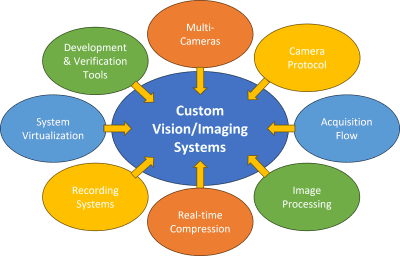
To simplify and accelerate FPGA development, Gidel provides the ProcVision Suite, a modular vision SDK designed for imaging and high-speed acquisition systems. ProcVision enables developers to build fully customized acquisition and processing flows using Gidel’s InfiniVision and ProcFG architectures. It supports inline ISP, HDR, debayering, noise reduction, and on-FPGA compression engines such as Quality+, Lossless, and JPEG.
Developers can insert their own proprietary algorithms directly into the FPGA pipeline, enabling real-time preprocessing and significant offloading of CPU and GPU resources. The suite includes the CertifEye validation environment, which streamlines testing and verification of custom IP. By using ProcVision, teams can deploy FPGA-accelerated imaging pipelines with a more integrated development and validation flow.
Scaling to 100+ Cameras with InfiniVision
Gidel’s approach scales even further through InfiniVision, the company’s open-FPGA acquisition and synchronization framework. InfiniVision enables distributed imaging systems that can capture, stream, and precisely synchronize 100+ cameras across multiple FantoVision units—maintaining deterministic timing and real-time performance. This type of large-scale synchronization benefits from FPGA-based acquisition and hardware timing rather than relying only on software-level coordination.
By combining FPGA determinism, GPU flexibility, ProcVision’s development flow, and InfiniVision’s large-scale synchronization, Gidel demonstrates that the future of many demanding real-time systems is not necessarily FPGA versus GPU, but FPGA + GPU working together. This combination can provide a better-balanced architecture by pairing deterministic high-bandwidth I/O and preprocessing with flexible GPU-based AI processing.
Read the Full FPGA vs GPU Interview
You can read the full interview on The Next Platform: FPGA vs GPU – Time for a Compute Rematch
Related Products
-
FantoVision20
Learn More -
SkyBoost-RT
Learn More -
FantoVision20-CL
Learn More -
FantoVision20-GigE
Learn More -
FantoVision40-CXP12
Learn More -
SkyBoost
Learn More -
FantoVision40
Learn More -
HDR Correction
Learn More -
ProcVision Suite
Learn More -
LL Compression
Learn More -
InfiniVision
Learn More -
ProcFG
Learn More -
Quality+ Compression
Learn More -
Proc1C10N-120GigE
Learn More -
Proc10N
Learn More -
JPEG Compression
Learn More