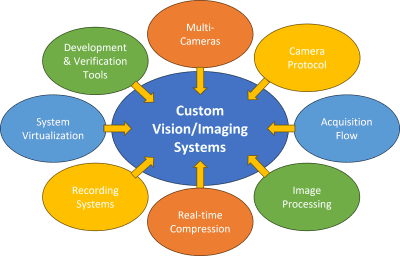
Frame Grabbers for High-Bandwidth Image Acquisition and Real-Time FPGA Processing
Frame grabbers are specialized image acquisition hardware that connect cameras to computing, processing, recording, or AI systems. A machine vision frame grabber, often referred to as an industrial frame grabber, receives camera data, reconstructs image streams, manages buffering and synchronization, and transfers images reliably to a CPU, GPU, NVIDIA Jetson, storage system, network, or other destination.
For many vision systems, the application requires exactly that: reliable, high-bandwidth image acquisition with minimal CPU involvement.
Advanced FPGA frame grabbers can go further. Because the incoming image stream already passes through the FPGA, this architecture supports FPGA image processing directly inside the acquisition path before the complete image data reaches host memory. This makes it possible to perform image enhancement, HDR correction, compression, ROI extraction, detection, preprocessing, data reduction, and application-specific processing with deterministic timing and very low added latency. This is part of Gidel’s broader focus on inline FPGA image processing across its acquisition and Edge AI platforms.
Gidel supports both architectures:
- Standard frame grabbing: high-performance plug-and-play acquisition without requiring the customer to develop FPGA logic.
- Frame grabbing with inline FPGA processing: acquisition combined with real-time processing using Gidel IP, customer FPGA IP, or application-specific processing developed by Gidel.
What Is a Frame Grabber?
A frame grabber, sometimes also described as a camera grabber, is image acquisition hardware that acquires images from one or more cameras and transfers the image data into a computing or processing system. In a complete image acquisition system, it provides the dedicated path between the camera interface and the downstream processing, recording, or AI platform. Depending on the interface and architecture, it can receive the camera signal, handle the protocol, reconstruct images, manage triggers and synchronization, buffer data, perform PCIe DMA, record or stream images, and optionally process image data in an FPGA.
At its most fundamental level, the job is simple:
Acquire every required image reliably and deliver it to the correct destination at the required rate.
At high camera rates, with multiple cameras, tight timing, or continuous recording, doing that reliably becomes a substantial system-engineering problem.
How Does a Frame Grabber Work?
A typical imaging pipeline follows this path:
Camera or image sensor → Camera interface → Frame grabber → Protocol processing → Frame reconstruction → Buffering → Optional FPGA processing → PCIe DMA → CPU, GPU, Jetson, storage, network, or application
The frame grabber receives the camera input, reconstructs the image data, and transfers or processes it according to the required acquisition pipeline.
In practice, the exact work depends on the interface. Camera Link uses a dedicated deterministic camera stream. CoaXPress uses one or more high-speed serial links. GigE Vision transports image data over Ethernet and requires high-rate packet handling and stream reconstruction.
Once the frame grabber reconstructs the image data, it can transfer the data to the host or process it first. Hardware DMA then moves the resulting data through PCIe with limited CPU intervention.
Why Are Frame Grabbers Still Needed in Modern Vision Systems?
Modern CPUs, GPUs, network adapters, and embedded processors are powerful enough that some camera systems no longer require dedicated acquisition hardware. The useful question is therefore not whether frame grabbers are universally required.
The useful question is:
Can the host platform reliably perform acquisition, synchronization, buffering, preprocessing, AI, storage, networking, and application processing at the required data rate and latency?
For example, a direct connection may be adequate for modest camera rates, a small number of cameras, relaxed synchronization, and applications with sufficient host resources. A dedicated frame grabber becomes more valuable as the application requires high sustained bandwidth, multiple simultaneous cameras, deterministic timing, precise triggering, large buffers, continuous recording, low CPU utilization, or processing directly in the acquisition path.
Do I Need a Frame Grabber for a Machine-Vision Camera?
Not always. Some cameras can connect directly to a host through standard computer interfaces. A dedicated frame grabber becomes more valuable when the application requires high sustained bandwidth, deterministic timing, specialized camera interfaces, precise synchronization, low CPU utilization, continuous recording, or inline processing before the image reaches the host.
What Is Deterministic Image Acquisition?
Deterministic acquisition means that timing-critical acquisition functions execute with controlled and predictable behavior rather than depending primarily on variable operating-system or application scheduling. This is especially important for triggering, synchronization, line-scan timing, repeatable latency, and coordinated multi-camera systems.
What Are the Main Advantages of a Frame Grabber?
Therefore, the main advantage of a frame grabber is that it creates a dedicated image-acquisition path instead of asking the host CPU, operating system, or general-purpose I/O hardware to manage every timing-critical camera task. The exact benefit depends on the camera interface.
- Reliable sustained image acquisition at high camera data rates
- Low-CPU DMA transfers into host memory
- Deterministic triggering and synchronization
- Large acquisition buffers for continuous imaging
- Support for specialized machine-vision interfaces such as Camera Link and CoaXPress
- Scalable multi-camera acquisition
- Optional inline FPGA processing before host transfer
- A controlled data path for recording, networking, GPU processing, or AI
- A dedicated industrial frame grabber card can isolate acquisition from general-purpose host I/O and software variability
Frame Grabber vs Standard NIC: When Does the Difference Matter?
By comparison, this distinction is especially relevant to GigE Vision. Camera Link and CoaXPress already require dedicated acquisition hardware in a typical PC, while GigE Vision cameras can also connect through standard Ethernet adapters.
| Requirement | Standard NIC | GigE Vision Frame Grabber |
|---|---|---|
| General Ethernet connectivity | Yes | Yes |
| GigE Vision acquisition | Software/host dependent | Dedicated camera-oriented acquisition path |
| High-rate packet handling | Primarily host/network-stack dependent | FPGA hardware handles high-rate packet processing |
| Image reconstruction | Host software dependent | The acquisition hardware reconstructs the image stream |
| CPU utilization | Can rise with camera count and packet rate | Can remain much lower for acquisition |
| Large image buffering | Depends on host architecture | Onboard buffering can be available |
| Precise multi-camera synchronization | Requires appropriate camera/network/software design | Can be integrated with dedicated trigger/synchronization logic |
| Inline FPGA image processing | No | Available on supported FPGA frame grabbers |
Frame Grabber vs Video Capture Card: What Is the Difference?
Both devices acquire image or video data, but they serve different system requirements. A machine-vision frame grabber is built around industrial or scientific camera interfaces, sustained acquisition, triggering, synchronization, high-rate DMA, and application integration. A conventional video capture card is generally designed for media or display interfaces and normally does not provide the same deterministic camera-control and acquisition functions.
Which Industries Benefit Most from Frame Grabbers?
A high-speed frame grabber is especially valuable in applications that require continuous real-time image acquisition, deterministic triggering, synchronized cameras, or sustained transfer of large image streams.
Frame grabbers become especially valuable when a system must acquire data from an industrial camera reliably at rates or timing requirements that justify dedicated acquisition hardware. Common applications include machine vision systems and industrial inspection, semiconductor inspection, scientific imaging, medical imaging, EO/IR and defense systems, airborne imaging, railway inspection, high-speed recording, robotics, Edge AI, and synchronized 3D or volumetric camera arrays.
In practice, the interface and processing architecture should follow the application. CoaXPress is often attractive for very high per-camera bandwidth, GigE Vision for flexible and distributed multi-camera connectivity, and Camera Link for established deterministic systems. FPGA processing becomes valuable when it solves a measurable latency, CPU/GPU, PCIe, storage, or network bottleneck.
Frame Grabber Types and Camera Interfaces
Gidel supports Camera Link frame grabbers, CoaXPress frame grabbers, and GigE Vision frame grabbers for different bandwidth, cabling, synchronization, and system-architecture requirements.
| Requirement | Camera Link | CoaXPress | GigE Vision |
|---|---|---|---|
| Architecture | Dedicated point-to-point imaging interface | High-speed serial point-to-point interface | Ethernet-based camera interface |
| Gidel configurations | Base, Medium, Full, 80-bit Deca, Dual Base | CXP-6 and CXP-12 | 1, 2.5, 5, 10 GigE Vision and higher aggregate Ethernet architectures |
| Primary strength | Deterministic acquisition and mature installed base | Very high per-camera bandwidth and multi-link scaling | Flexible topology, cable reach, and scalable multi-camera connectivity |
| Main design bottleneck | Configuration bandwidth and cabling | Link count, aggregate payload, PCIe, memory, and downstream processing | Packet handling, aggregate network bandwidth, synchronization, and host load |
| Where FPGA processing adds value | Adds modern processing to established Camera Link systems | Reduces very large raw streams before downstream transfer | Combines dedicated network acquisition and image processing in one hardware path |
Camera Link frame grabbers
Engineers commonly select Camera Link frame grabbers for deterministic industrial, scientific, medical, defense, and line-scan systems. A Camera Link frame grabber must support the required camera configuration, timing, trigger architecture, and sustained throughput.
Camera Link Frame Grabbers support established Base, Medium, Full, 80-bit Deca, and Dual Base camera architectures. They are also used in high-speed imaging systems where deterministic acquisition and precise synchronization are important. Engineers evaluating cameras can also review Gidel’s Camera Link Cameras guide.

Do Camera Link Cameras Require a Frame Grabber?
In a typical PC-based system, yes. Camera Link is a dedicated machine-vision interface that standard PCs do not include, so the system requires compatible Camera Link acquisition hardware. The selected frame grabber must support the required Base, Medium, Full, Deca, or Dual Base configuration, together with the camera timing, trigger, and throughput requirements.
CoaXPress frame grabbers
CoaXPress frame grabbers are commonly selected for high-speed imaging systems that require very high per-camera bandwidth, multi-link acquisition, precise triggering, and deterministic data transfer. A CoaXPress frame grabber, often shortened to CXP frame grabber, must support the required CXP generation, link count, aggregate bandwidth, synchronization architecture, and PoCXP requirements.
CoaXPress Frame Grabbers support CXP-6 and CXP-12 cameras, including high-bandwidth multi-link configurations. They are particularly relevant when the acquisition platform must manage large image streams, synchronization, buffering, and sustained PCIe transfer. For camera selection and link-count planning, see the CoaXPress Cameras guide.

Do CoaXPress Cameras Require a Frame Grabber?
In a typical PC-based system, yes. Standard PCs do not provide native CoaXPress camera ports, so the system requires compatible CXP acquisition hardware. The frame grabber must provide the correct CXP version, number of links, aggregate bandwidth, trigger architecture, and PoCXP capability when required.
What Is the Difference Between CXP-6 and CXP-12?
CXP-6 and CXP-12 are CoaXPress connection speed grades. CXP-6 operates at 6.25 Gb/s signaling rate per link, while CXP-12 operates at 12.5 Gb/s per link. Multi-link cameras can aggregate several connections to increase total interface bandwidth. Usable image payload is lower than the physical signaling rate because of encoding and protocol overhead. For full-rate operation, both the camera and frame grabber must support the required CXP speed.
What Do PoCXP and PoCL Mean?
PoCXP (Power over CoaXPress) and PoCL (Power over Camera Link) let a frame grabber deliver power to the camera over the same cable used for data, image, and control signals. This removes the need for a separate camera power supply and cable, which simplifies installation, particularly in multi-camera, embedded, or space-constrained systems. Not every camera or frame grabber configuration requires or supports it, so it should be confirmed as part of interface planning.
GigE Vision frame grabbers
GigE Vision frame grabbers are commonly selected for high-bandwidth or multi-camera systems that require scalable Ethernet connectivity, continuous image acquisition, synchronization, and reduced host involvement in packet processing. A GigE Vision frame grabber, often shortened to GigE frame grabber, must support the required camera count, aggregate Ethernet bandwidth, packet rate, synchronization requirements, and downstream processing architecture.
GigE Vision Frame Grabbers are designed around continuous image acquisition from Ethernet cameras while reducing host involvement in packet and image handling. They become especially valuable as camera count, aggregate bandwidth, synchronization requirements, or continuous recording demands increase. For Ethernet-rate and camera-selection guidance, see the guide to GigE Vision camera selection.

Do GigE Vision Cameras Require a Frame Grabber?
Not always. GigE Vision cameras can operate through standard Ethernet hardware when the host, network, and software can sustain the required workload. A dedicated GigE Vision frame grabber becomes increasingly useful as aggregate bandwidth, packet rate, camera count, synchronization, buffering, continuous acquisition, CPU load, or inline FPGA processing requirements increase.
Standard Frame Grabber vs Frame Grabber with Inline FPGA Processing
A standard frame grabber primarily solves the image acquisition problem. A frame grabber with inline FPGA processing can solve the acquisition problem and selected processing and downstream-bandwidth problems before the complete image reaches the host.
Therefore, the distinction is not that one architecture is universally better. The important question is whether moving suitable processing into the camera acquisition path removes a measurable system bottleneck.
What Is an FPGA Frame Grabber?
An FPGA frame grabber uses programmable logic to implement camera acquisition and related data-handling functions. The same FPGA can also perform optional FPGA image processing, compression, synchronization, enhancement, data reduction, or application-specific algorithms directly in the acquisition path.
Does an FPGA Frame Grabber Require FPGA Programming?
No. An FPGA-based frame grabber can operate as a standard plug-and-play acquisition device. Customers need FPGA development only when they want to add or modify FPGA processing functionality.
What Is the Customer Benefit of Inline FPGA Processing?
The strongest reason to process images inside a frame grabber is not simply that an FPGA is available. The advantage comes from where the FPGA is located in the data path.
One of the most important benefits is CPU offload. By moving suitable acquisition, correction, filtering, ROI handling, format conversion, and compression tasks into the FPGA, the frame grabber can reduce the amount of work performed by the host CPU and preserve CPU resources for application software, control, networking, and higher-level vision processing.
As a result, the image is already passing through the FPGA before it reaches the host, so appropriate processing can reduce unnecessary data movement and downstream computation.
Advantages of Frame Grabbers with Inline FPGA Processing
| System Bottleneck / Requirement | How FPGA Processing Helps | Customer Benefit |
|---|---|---|
| Processing latency | Pixel- or line-based processing can begin while the image is still arriving. | Lower and more predictable latency for suitable streaming algorithms. |
| CPU offload / reduced CPU load | Acquisition-related correction, filtering, ROI handling, format conversion, or compression can run in FPGA hardware. | Reduces host CPU workload and preserves CPU resources for application software, networking, control, and higher-level processing. |
| GPU / Jetson preprocessing load | The FPGA can complete suitable image conditioning before data reaches the GPU. | Preserves GPU or Jetson resources for AI inference, tracking, segmentation, or CUDA workloads. |
| PCIe and host-memory bandwidth | ROI extraction, binning, selective transfer, filtering, or compression can reduce data before DMA. | Less data crosses PCIe and enters host memory. |
| Storage bandwidth and capacity | Compression or selective recording can reduce the stored image stream. | Lower SSD write requirements and longer recording time. |
| Network output bandwidth | The FPGA can forward compressed or reduced data instead of the complete raw stream. | Lower transmission bandwidth when the system streams or retransmits processed data. |
| Application-specific processing | Gidel IP, application-specific Gidel development, or customer FPGA IP can run directly in the acquisition path. | Creates a customized imaging pipeline without rebuilding the acquisition, PCIe, memory, and software infrastructure. |
Which Image Processing Operations Can Run in the FPGA?
Examples of suitable inline operations include ROI extraction, gain and offset correction, white balance, debayering, gamma correction, dynamic luminance processing, NUC, bad-pixel correction, chromatic-aberration correction, HDR, filtering, JPEG compression, Lossless compression, Quality+ compression, detection, image statistics, and custom customer algorithms.
However, not every operation belongs in the FPGA. Algorithms that change frequently, require complex software control, or are already highly efficient on a CPU or GPU may be better left downstream. Engineers should treat FPGA, CPU, GPU, and Jetson as complementary processing resources.
Three ways to add FPGA processing
- Use Gidel off-the-shelf FPGA IP: integrate existing image-processing, HDR, compression, detection, or enhancement functions.
- Let Gidel develop the processing: implement application-specific FPGA functionality without requiring the customer to build the complete acquisition platform.
- Integrate customer FPGA IP: combine proprietary customer algorithms with Gidel camera acquisition, memory, PCIe, synchronization, and software infrastructure.
Can a Frame Grabber Process Images Before They Reach the Host?
Yes, when the hardware and FPGA architecture support inline processing. Suitable operations can execute directly during acquisition before the image reaches the CPU, GPU, Jetson, storage system, or downstream network path.
Can FPGA Processing Reduce CPU, GPU, PCIe, or Storage Load?
Yes, when the processing reduces or transforms data before host transfer. Examples include ROI extraction, binning, filtering, image correction, compression, selective transfer, and metadata generation. The benefit depends on the actual pipeline and on whether the downstream system would otherwise perform the same work or move the same raw data.
Is FPGA Always Faster Than a CPU or GPU for Image Processing?
No. FPGA, CPU, GPU, and Jetson resources have different strengths. FPGAs are particularly effective for deterministic streaming pipelines and processing before host transfer. CPUs provide software flexibility, while GPUs are highly effective for massively parallel computation and AI. The strongest architecture often combines them.
PCIe Frame Grabbers: Gidel Product Family
Gidel’s PCIe Frame Grabbers install in a host computer and support Camera Link, CoaXPress, and GigE Vision acquisition. The portfolio ranges from compact interface cards to high-bandwidth multi-camera FPGA platforms with optional inline processing.
What PCIe Slot Does a Frame Grabber Need?
The required slot depends on the board’s PCIe generation and lane width, such as x4, x8, or x16. Engineers should verify both mechanical fit and the number of electrically available lanes, while also considering CPU and chipset lane allocation, PCIe switches, GPUs, NVMe devices, and other expansion cards.
Can a Frame Grabber Be Used With a Laptop?
Not directly in most cases. Standard laptops do not expose an internal PCIe slot, so a PCIe frame grabber generally requires a desktop workstation, industrial PC, server, or a PCIe expansion chassis. Systems that must stay laptop-sized or fully portable are typically better suited to an embedded architecture such as FantoVision, which integrates acquisition and processing without depending on a host PCIe slot.
What Is DMA in a Frame Grabber?
Direct Memory Access allows acquired image data to move through PCIe into host memory with limited CPU intervention. Efficient DMA is essential for sustaining high image throughput while preserving CPU resources for the application.
Can a Frame Grabber Transfer Images to a GPU?
Yes. Frame-grabber systems can deliver acquired images into host memory for downstream GPU processing. The exact transfer path and achievable performance depend on the frame grabber, host platform, GPU, operating system, driver architecture, memory topology, and application software.
Gidel PCIe Frame Grabber Comparison
| Product | Camera Interface | Key Configuration | Best Fit / Main Need |
|---|---|---|---|
| HawkEye-CL | Camera Link | Base, Medium, Full, 80-bit Deca, or Dual Base; optional PoCL | Established Camera Link systems that need deterministic acquisition, precise triggering, and optional inline FPGA processing |
| HawkEye-CXP12 | CoaXPress-12 | Up to 4 × CXP-12 links with PoCXP | Compact high-bandwidth CXP-12 systems that need multi-link acquisition and inline FPGA processing |
| Proc10A-CXP | CoaXPress-6 | Up to 8 × CXP-6 links with PoCXP; Arria 10 FPGA and large onboard memory options | High-link-count CXP-6 acquisition where buffering, multi-camera throughput, and custom FPGA processing are important |
| Proc1C10N-CXP12 | CoaXPress-12 | Up to 8 × CXP-12 links, 100 Gb/s aggregate interface bandwidth, Stratix 10 NX with HBM2 | Very high CXP-12 bandwidth with large-memory FPGA processing and FPGA AI acceleration |
| HawkEye-20GigE | GigE Vision | Up to 2 × 10 GigE, 4 × 5 GigE, 8 × 2.5 GigE, or 20 × 1 GigE camera connections | Compact GigE Vision acquisition where packet handling, multi-camera scaling, and FPGA processing need to be offloaded from the host |
| Proc10A-40GigE | GigE Vision | Up to 4 × 10 GigE cameras; Arria 10 FPGA; up to 33 GB onboard memory | Multi-camera 10 GigE acquisition that needs deep buffering, recording support, and inline FPGA processing |
| Proc1C10M-120GigE | High-bandwidth Ethernet / GigE Vision | Up to 12 × 10 GigE cameras with 100 GigE connectivity options | Very high aggregate Ethernet acquisition for large multi-camera systems and high-throughput recording or processing |
| Proc1C10N-120GigE | High-bandwidth Ethernet / GigE Vision | Up to 12 × 10 GigE cameras with 100 GigE connectivity options; Stratix 10 NX architecture | Very high aggregate GigE Vision acquisition when additional FPGA AI and compute capability is required |
FantoVision: Mini Jetson Edge AI with Built-In Frame Grabbers
The FantoVision Edge AI family integrates NVIDIA Jetson processing with a built-in FPGA frame grabber in a compact embedded imaging and Edge AI system. Instead of installing a PCIe acquisition card in a host PC, FantoVision places camera acquisition, deterministic FPGA processing, compression, and Edge AI processing in one platform close to the cameras.
This architecture is especially useful when the system must operate without a conventional host PC, when size and integration matter, or when the application benefits from dividing work between the FPGA and Jetson:
FPGA: camera acquisition + synchronization + image conditioning + compression + data reduction
Jetson: CUDA processing + AI inference + classification + segmentation + tracking + application software
What Is a Jetson Frame Grabber?
A Jetson frame grabber provides a high-performance camera-acquisition path for an NVIDIA Jetson-based system. In an integrated FPGA + Jetson architecture such as FantoVision, the FPGA handles deterministic acquisition and suitable preprocessing while Jetson provides CUDA processing, AI inference, tracking, classification, segmentation, and application software.
Gidel FantoVision System Comparison
| Product | Camera Interface | Main Configuration | Best Fit |
|---|---|---|---|
| FantoVision20-CL | Camera Link | NVIDIA Jetson + Arria 10 FPGA; Base, Medium, Full, 80-bit Deca, or Dual Base; optional PoCL and inline FPGA processing | Embedded Edge AI systems that must keep existing Camera Link cameras while adding FPGA preprocessing and Jetson AI |
| FantoVision40-CXP12 | CoaXPress-12 | NVIDIA Jetson Orin NX + FPGA; up to 4 × CXP-12 links with PoCXP; optional inline FPGA processing | Compact high-bandwidth Edge AI for CXP-12 cameras, including EO/IR, industrial, medical, and multi-sensor imaging |
| FantoVision20-GigE | GigE Vision | NVIDIA Jetson + Arria 10 FPGA; up to 2 × 10 GigE Vision, 4 × 5 GigE, 8 × 2.5 GigE, or 15 × 1 GigE cameras; optional inline FPGA processing | Compact multi-camera GigE Vision Edge AI where FPGA acquisition and preprocessing should preserve Jetson resources for AI |
| FantoVision20 | GigE Vision + Camera Link | NVIDIA Jetson + Arria 10 FPGA; combined GigE Vision + Camera Link acquisition, up to 26.8 Gb/s combined interface bandwidth; optional inline FPGA processing | Mixed-interface embedded systems that need GigE Vision and Camera Link acquisition in one Jetson + FPGA platform |
| FantoVision40 | CoaXPress-12; configurable with optional 10GigE Vision connectivity | NVIDIA Jetson Orin NX + FPGA; up to 4 × CXP-12 links with PoCXP; can also be configured with optional high-bandwidth 10GigE Vision connectivity | Flexible Edge AI systems that need high-bandwidth camera acquisition, FPGA preprocessing, Jetson AI, and expanded interface options |
PCIe Frame Grabber vs Edge AI with FPGA: Which Architecture Should You Choose?
In practice, the comparison is between two system architectures: a PCIe frame grabber installed in a host computer, and an Edge AI system with built-in FPGA frame grabbers, represented here by Gidel FantoVision. Both can provide high-bandwidth acquisition and inline FPGA processing. The deciding factor is usually where the CPU/GPU, AI, storage, and application software should run.
| System Requirement | PCIe Frame Grabber | Edge AI with Built-In FPGA Frame Grabber (FantoVision) |
|---|---|---|
| Main architecture | PCIe card installed in a host computer | Integrated NVIDIA Jetson + FPGA frame grabber system |
| Best when | The application already uses a workstation, server, or industrial PC | The application needs a compact embedded computer close to the cameras |
| CPU / GPU environment | Uses host CPU and optional discrete GPU | NVIDIA Jetson CPU/GPU is integrated |
| FPGA processing | Optional inline processing before PCIe host transfer | Optional inline processing before Jetson-side AI or software processing |
| Scalability | Well suited to multi-card host systems and very large acquisition architectures | Optimized for compact embedded deployment and distributed edge systems |
| Typical decision driver | Host integration, PCIe expansion, large memory/storage, discrete GPU or existing PC infrastructure | Size, integration, low-SWaP deployment, on-device AI, and eliminating the external host PC |
Not Sure Which Frame Grabber Architecture Fits Your System?
Tell us your camera interface, bandwidth, and deployment constraints. Our experts will help you find the right architecture and configuration before you commit to hardware.
How Do You Calculate Frame Grabber Bandwidth?
A first-order raw image-data calculation is:
Width × Height × Frame Rate × Bits per Pixel
For multiple cameras:
Width × Height × Frame Rate × Bits per Pixel × Number of Cameras
For example, a 20-megapixel monochrome camera at 30 FPS and 12 bits per pixel generates approximately 7.2 Gb/s, or 900 MB/s, of raw image data. Two such cameras generate approximately 14.4 Gb/s and four generate approximately 28.8 Gb/s before protocol overhead, metadata, image packing, or processing expansion.
Engineers should distinguish raw sensor rate, physical interface signaling rate, usable protocol payload, aggregate camera bandwidth, frame-grabber acquisition throughput, onboard memory bandwidth, PCIe payload throughput, host-memory bandwidth, storage write bandwidth, and network output bandwidth. A camera-interface headline number is not automatically equal to sustainable end-to-end system throughput.
Does a Frame Grabber Increase Camera Frame Rate?
No. A frame grabber cannot make a camera exceed the limits of its sensor, readout electronics, or camera interface. Its role is to acquire the available stream reliably. A correctly selected frame grabber helps the system sustain the camera’s required rate without dropped frames or avoidable host-side acquisition bottlenecks.
What Causes Dropped Frames in High-Speed Camera Systems?
Dropped frames normally indicate a bottleneck somewhere in the complete data path. Possible causes include insufficient camera-interface bandwidth, packet loss, inadequate receive buffers, PCIe congestion, host-memory limitations, CPU scheduling, software that cannot keep pace, storage that cannot sustain the write rate, network-output limits, or an incorrect trigger/synchronization architecture.
Engineers should therefore evaluate the complete system as an end-to-end imaging architecture rather than as an isolated board.
What Determines Frame Grabber Latency?
End-to-end latency can include sensor exposure and readout, camera serialization, interface transmission, packetization, frame accumulation, buffering, FPGA processing, PCIe transfer, operating-system scheduling, CPU/GPU processing, AI inference, and display or control-response latency.
For suitable algorithms, FPGA processing can reduce latency because processing can begin on pixels or lines before a complete frame has arrived. Algorithms that require a complete image or multiple images may still require frame buffering, so engineers should always evaluate latency against the actual processing pipeline.
Multi-Camera Frame Grabbers and Synchronized Acquisition
InfiniVision architecture supports scalable synchronized acquisition and processing across multi-board systems, including architectures with 100+ cameras.
How Many Cameras Can One Frame Grabber Support?
However, there is no single number. The answer depends on the camera interface, number of physical ports or links, resolution, frame rate, pixel depth, aggregate board throughput, trigger requirements, onboard buffering, processing load, and PCIe capacity. Large systems can also distribute acquisition across multiple synchronized frame grabbers.
Can I Use More Than One Frame Grabber in the Same Computer?
Yes, provided the host has enough physical and electrical PCIe slots, sufficient lane bandwidth, and driver/software support for multiple boards. This is a common way to scale beyond what a single frame grabber can support, and it is the basis for InfiniVision-class architectures that synchronize acquisition and processing across multiple boards. Power, cooling, and PCIe lane allocation across the motherboard’s chipset should be verified as camera count grows.
Can Frame Grabbers Be Used with Line-Scan Cameras?
Yes. Frame grabbers are widely used with line-scan cameras. Important requirements include interface compatibility, line rate, pixel clock or link bandwidth, trigger or encoder handling, buffering, image reconstruction, and sustained downstream throughput.
Frame Grabber Software, APIs and FPGA Development
Developers must integrate frame-grabber hardware into the application through drivers, acquisition APIs, DMA and buffer management, camera configuration, trigger control, diagnostics, recording support, and performance monitoring.
For customers that want to customize FPGA image processing, Gidel’s ProcVision Suite provides an environment for development, debugging, verification, and integration while retaining Gidel’s existing camera, memory, PCIe, DMA, and software infrastructure.
The environment includes tools and architectures such as CertifEye, ProcFG, InfiniVision, Camera Simulators, and ProcDev Kit. This allows engineering effort to focus on the application-specific processing rather than rebuilding the complete frame-grabber infrastructure.
How to Select the Right Frame Grabber
Therefore, selection should begin with the complete image-data flow rather than with a single board specification. Engineers should evaluate:
- Camera interface: Camera Link, CoaXPress, GigE Vision, or another interface.
- Number of simultaneous cameras: Calculate aggregate bandwidth, not only the bandwidth of one camera.
- Resolution, frame rate, and pixel depth: These determine the raw image payload.
- Physical links or ports: Especially important for multi-link CoaXPress and multi-camera Ethernet systems.
- PCIe interface: Verify generation, lane width, electrical lanes, motherboard topology, and other competing PCIe devices.
- Synchronization: Define trigger, timing, timestamp, encoder, and frame-alignment requirements.
- Required host data: Determine whether the host needs the complete raw image or only ROI, compressed, corrected, reduced, or selected data.
- Processing location: Decide which operations belong in FPGA, CPU, GPU, Jetson, or a heterogeneous processing pipeline.
- Recording and networking: Check whether compression or data reduction should occur before PCIe, storage, or network transmission.
- Custom FPGA processing: Determine whether to use Gidel IP, customer FPGA IP, Gidel development, or a joint implementation.
- Mechanical and environmental requirements: Consider form factor, power, cooling, operating temperature, shock, vibration, and embedded versus host-PC deployment.
- Product lifetime and engineering support: Long-life industrial, scientific, medical, and defense systems may require extended support and adaptable acquisition architectures.
What Affects Frame Grabber Price?
Frame grabber price varies considerably depending on the acquisition requirements rather than following a single fixed rate. Several factors typically drive the difference between an entry-level frame grabber card and a high-end multi-camera platform:
- Camera interface: Camera Link, CoaXPress, and GigE Vision each require different acquisition hardware, and link count or Ethernet speed within an interface also affects cost.
- Camera count and aggregate bandwidth: Boards supporting a single camera are generally priced lower than multi-camera or high-aggregate-bandwidth platforms.
- Onboard memory: Larger buffering capacity for continuous recording or multi-camera synchronization adds to the price.
- FPGA processing tier: Boards with inline FPGA image processing, compression, or AI acceleration (such as Tensor Blocks) typically cost more than standard plug-and-play acquisition cards.
- Architecture: A PCIe frame grabber card generally has a different price point than a complete Edge AI system such as FantoVision, which integrates acquisition, FPGA processing, and NVIDIA Jetson compute in one platform.
Because these factors combine differently for every application, frame grabber pricing is best evaluated against the complete system requirement rather than compared as a single number across products.
Why Choose Gidel Frame Grabbers?
Gidel has more than 30 years of experience developing FPGA-based systems for high-performance imaging, vision, acquisition, and data processing. The differentiation is not simply the use of FPGAs. It is the ability to use the same acquisition technology in several ways:
- Standard frame grabber: plug-and-play acquisition without customer FPGA development.
- Frame grabber + Gidel FPGA IP: add existing HDR, image-processing, detection, or compression functions.
- Frame grabber + custom Gidel processing: add application-specific processing developed for the required imaging flow.
- Frame grabber + customer FPGA IP: combine proprietary algorithms with Gidel acquisition, memory, PCIe, synchronization, and software infrastructure.
- FantoVision embedded architecture: combine FPGA acquisition and processing with NVIDIA Jetson Edge AI in one compact system.
Gidel FPGA frame grabbers can also provide CPU offload by moving suitable acquisition and image-preprocessing functions into the FPGA before host transfer.
Which Applications Benefit from PCIe Frame Grabbers vs Edge AI with Built-In Frame Grabbers?
The final choice is usually architectural rather than interface-driven. PCIe frame grabbers are designed for host-based systems, while Edge AI systems with built-in FPGA frame grabbers, such as FantoVision, integrate acquisition, FPGA processing, and NVIDIA Jetson compute in one compact platform. Both product families can provide deterministic acquisition and inline FPGA processing. They simply place the rest of the application in different locations.
| Application / System Need | PCIe Frame Grabber | Edge AI with Built-In FPGA Frame Grabber |
|---|---|---|
| Existing workstation, server, or industrial PC | Strong fit | Usually unnecessary unless edge deployment is also required |
| Discrete GPU or large host compute resources | Strong fit | Jetson provides integrated GPU compute instead |
| Multiple PCIe cards or very large host-based acquisition | Strong fit | Less suitable for large multi-card host architectures |
| Compact embedded system near the cameras | Possible with custom host integration | Strong fit |
| Low-SWaP Edge AI deployment | Possible but usually requires more system integration | Strong fit |
| Integrated NVIDIA Jetson AI | External Jetson or GPU integration required | Built in |
| Camera acquisition + preprocessing + AI in one enclosure | Requires host-system integration | Strong fit |
| Large host storage / RAID / server networking | Strong fit | Possible through external interfaces, but not its primary architectural advantage |
Frame Grabbers Are No Longer Just About Moving Images into a PC
Even so, the traditional definition remains correct: a frame grabber acquires images from cameras and transfers them into a computer. Modern systems, however, must also manage synchronization, PCIe and host-memory bandwidth, CPU/GPU utilization, processing latency, storage, networking, power, and development complexity.
A high-performance frame grabber can therefore serve two roles:
First, it can be a reliable plug-and-play acquisition device.
Second, when the application requires more, it can become the first processing stage of the imaging architecture.
That is where FPGA-based frame grabbers provide their greatest architectural flexibility. The correct starting point is the camera interface. The correct finishing point is the complete data path:
Camera → Acquisition → Processing → PCIe or Jetson → CPU/GPU → Storage/Network → Application
Optimizing that complete path is what turns a frame grabber from a camera-interface card into a high-performance imaging architecture.
Related Products
-
HawkEye-CL
Learn More -
HawkEye-CXP12
Learn More -
Proc10A-CXP
Learn More -
Proc1C10N-CXP12
Learn More -
HawkEye-20GigE
Learn More -
Proc10A-40GigE
Learn More -
Proc1C10M-120GigE
Learn More -
Proc1C10N-120GigE
Learn More -
FantoVision20-CL
Learn More -
FantoVision40-CXP12
Learn More -
FantoVision20-GigE
Learn More -
FantoVision20
Learn More -
FantoVision40
Learn More -
InfiniVision
Learn More -
HDR Correction
Learn More -
JPEG Compression
Learn More -
LL Compression
Learn More -
Quality+ Compression
Learn More -
ProcVision Suite
Learn More -
SkyBoost-RT
Learn More