
Reuven Weintraub, founder and CTO of Gidel, reveals how to unlock exceptional image processing performance by adding FPGA’s processing at Vision Show, Stuttgart 2024.
Ultra-High Performance Stratix10NX HBM2 Module, Ideal for AI
- Ultra-Compact FPGA For AI (Stratix 10NX 2100).
- Tensor blocks: 143 INT8 TOPS / FP16 TFLOPS
- Dimensions: 97.4mm x 101mm
- Inline FPGA image processing options include:
- Real-time detection for object, event, or feature identification
- On-FPGA real-time compression: JPEG, Lossless, Quality+
- Real-time High Dynamic Range (HDR) correction
- 300GB/s DRAM Throughput.
- Up to 128GB DDR4 on Carrier board.
- 8GB HBM2 DRAM.
- 72 Transceivers, up to 26Gb/s.
- Up to 374 I/Os.
Proc10N: Compact FPGA for AI and High-Performance Embedded Systems
The Proc10N™ is a compact FPGA for AI module powered by the Altera Stratix® 10 NX FPGA. It delivers exceptional performance for AI acceleration, compute-intensive processing, and low-latency edge systems. With integrated Tensor Blocks, HBM2 memory, and high-bandwidth data interfaces, the Proc10N offers unparalleled throughput for high-speed embedded designs. Moreover, its compact form factor ensures seamless integration into advanced embedded platforms while maintaining maximum compute capability.
Performance and Memory in the Proc10N Module
Each Proc10N module integrates HBM2 memory, providing 10× higher DRAM/SRAM bandwidth compared to discrete DDR4 and QDR technologies. It also delivers 143 INT8 TOPS / FP16 TFLOPS through dedicated Tensor Blocks and offers 1,600 Gb/s of customizable I/O for extreme data throughput. Consequently, the Proc10N delivers industry-leading compute density at a competitive SWaP profile. Additionally, its robust hardware architecture ensures reliable operation in demanding, mission-critical environments and provides a long-term, cost-efficient solution for complex embedded systems. Therefore, it is ideal for applications requiring deep learning, real-time inference, high-bandwidth acquisition, and deterministic system behavior.
AI-Focused Processing Module with Real-Time FPGA Image Processing
The Proc10N is available as a high-performance FPGA module for AI, high-bandwidth compute, and embedded imaging systems, or as part of a complete Imaging & Vision solution with real-time FPGA preprocessing, image enhancement, and compression options.
The built-in FPGA can process image data directly at the edge, close to the camera interface and before the data reaches the host system. This helps reduce bandwidth, storage, and host processing load while preserving low-latency performance for compact high-speed imaging applications.
Optional FPGA processing includes Compression, HDR correction, Detection, and additional image enhancement modules.
Real-Time FPGA Processing Helps Enable:
- Reduced bandwidth for high-throughput image acquisition
- Low-latency processing directly in the acquisition flow
- Extended recording time through real-time compression
- Lower host processing load by offloading selected tasks to the FPGA
- Custom image pipelines using Gidel IPs or user FPGA logic
For the full list of available image processing and enhancement options, please refer to the Options tab.
Integrated Vision Architecture for Embedded FPGA Processing
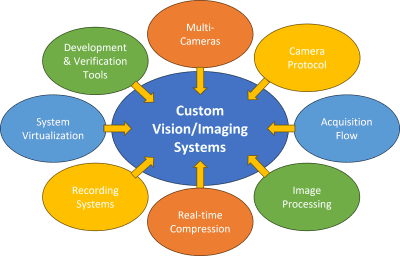
Gidel’s vision architecture, implemented on the Proc10N FPGA modules, supports both the InfiniVision multi-camera vision system and the ProcFG deterministic image acquisition system. Together, they address high-bandwidth acquisition, synchronization, buffering, and scalable processing requirements in demanding vision platforms.
InfiniVision enables flexible, synchronized acquisition across large camera arrays and multi-stream configurations, while ProcFG provides a deterministic acquisition model optimized for fixed timing, guaranteed frame capture, and line-scan–oriented pipelines. This dual approach allows Proc10N module to handle multiple high-speed data sources, merge parallel sensor inputs, and maintain predictable real-time behavior under sustained load.
With high-performance FPGA resources, on-board memory, and deterministic dataflow control, the Proc10N module support stable acquisition and real-time image processing at scale. As a result, they deliver reliable and predictable performance in high-throughput, high-resolution vision systems where bandwidth density and timing control are critical.
Flexible Integration Options
The Proc10N adapts to diverse integration needs. It can operate as a standalone AI/processing engine or as part of a fully customized solution including FPGA-based image enhancement, real-time compression, multi-sensor aggregation, and advanced I/O control. As a result, the Proc10N provides exceptional flexibility and scalability for high-bandwidth vision, AI, and sensing architectures.
SDK, Development Tools, and Integration
The Proc10N is supported by Gidel’s SDK, providing intuitive GUIs and APIs for streamlined system integration. Additionally, the ProcVision Suite offers advanced FPGA programming, debugging, and validation tools. Consequently, developers can rapidly build custom dataflows, AI pipelines, and high-bandwidth processing systems while reducing development time and integration risk.
The module also benefits from Gidel’s advanced multi-port memory architecture, enabling efficient access to HBM2 resources and supporting hundreds of simultaneous operations. Furthermore, each module is supported by Gidel or customer-designed carrier boards, enabling immediate system bring-up and rapid prototyping. As a result, development cycles are shortened, reliability is improved, and time-to-market is accelerated — making the Proc10N ideal for fast-paced, mission-critical industries.
Why Choose the Proc10N?
AI-focused FPGA module for high-performance embedded and edge systems
Compact footprint: 97.4 × 101 mm
HBM2 memory for high-bandwidth data movement and AI acceleration
Advanced SDK and ProcVision Suite for rapid development and integration
Optional real-time FPGA processing, image enhancement, and compression IPs
The Proc10N is the ideal choice when your workload requires FPGA-based AI acceleration, high-throughput data handling, and compact integration into advanced embedded or edge systems.
Related Products
View the Full FPGA Modules Range
General
FPGA
Stratix 10 NX 2100
DRAM Throughput
300 GB/s
On-board Memory
Up to 128 GB on Carrier board
On-FPGA DRAM
8 GB HBM2
Transceivers
72
Transceivers speed
Up to 26 Gb/s
I/Os
Up to 378 I/Os:
- 26 × 3.3V
- 96 x LVDS
- 72-bit DDR4 Interface
- 4 × 1.8V
Dimensions
97.4mm x 101mm
Weight
385g
Real-Time FPGA Image Compression
Supports optional FPGA-based compression options.
For the full list, please refer to the Options tab.
For the full list, please refer to the Options tab.
Real-Time FPGA Image Processing & Enhancements
Supports optional FPGA image processing and enhancement modules.
For the full list, please refer to the Options tab.
For the full list, please refer to the Options tab.
Logic Emlements
2,073K
FPGA SRAM
94.5 Mb @ 90 GB/s
M20K
6800
18x19 MAC
7,920
INT8/FP16 Tensor MAC
118,800
Environmental conditions
Temperature
Operating ambient air temperature: 0 – 55° C
Humidity
- Continuous Operation: 10 - 80% (non-condensing)
- Peak Operation: 10 - 90% (non-condensing)
Environmental Compliance
The Proc10N module has been designed for use with carrier boards enabling to quickly tailor the peripheral I/O interface without the need to invest valuable resources in developing FPGA infrastructure and its encompassing ASP. User carriers may incorporate any combination of Rx, Tx or full duplex transceivers.
Gidel’s off-the-shelf carrier board can be used as is for deployment or as a reference design thus further improving the ROI.
Want to adjust our Proc10N Module according to your Vision?
The Proc10N FPGA module offers two powerful customization paths to meet specific application requirements:
- Pre-Configured FPGA Features
Gidel develops a range of pre-embedded modules tailored to your specifications, including real-time compression, image processing, and enhancement options.
For the full list of image processing and enhancements, please refer to the Options tab. - User-Level FPGA Customization
Leverage Gidel’s development tools and IP libraries to integrate your proprietary FPGA logic and extend the system’s capabilities for acquisition, image processing, and control.
The Gidel ProcVision Suite delivers a complete toolchain for advanced user-level FPGA customization of the data flow, image pipeline, image processing, and more, ensuring optimal performance for your vision or imaging application.
Gidel can also integrate customer algorithms into the FPGA or develop custom FPGA logic according to specific application requirements.
Grabbers SDK
InfiniVision
Designed for acquisition from a large number of cameras (100+), with an option for embedded real-time compression.
ProcFG
Optimized for line-scan camera acquisition, combining ROI-based grabbing with integrated debugging and analysis tools.
Application Interfaces
GUI Applications
- InfiniVision
- ProcFG
- CameraConfig – Camera discovery and configuration
- ggvcon – GigE Vision network configuration
APIs
- InfiniVision with supporting examples
- ProcFG with supporting examples
- Gen<i>Cam GenTL producer libraries compatible with C/C++ compilers
- InitCam for developing user Gen<i>Cam camera configuration application
- GigE for developing camera network communication applications
Software Compatibility
Third-party software
- MVTec Halcon machine vision software
- Camera control Gen<i>Cam based application
Operation Systems supported
- Windows 11
- Windows 10
- Windows Server 2022
- Windows Server 2019
- Windows Server 2016
- Linux (kernel 2.6.x- 6.12)
| Name | Description | Type | Size | |
|---|---|---|---|---|
Proc10N: Datasheet | FPGA module | 194.4 KB | ||
Proc10N: Block Diagram | FPGA module | JPG | 73.9 KB | |
Proc10N | Memory Performance Comparison | JPG | 69.3 KB | |
Proc10N - Press Release | Gidel Proc10N Product Launch | 83.0 KB |
Related Videos
Gidel founder and CTO explain the benefits of Gidel's Altera-based high-performance FPGA modules for fast and easy development.
Gidel presented its FPGA-based architecture capable of processing Giga+ Pixels per second while maintaining exceptionally low power consumption.
The session demonstrated how Gidel’s scalable FPGA solutions deliver real-time imaging performance, energy efficiency, and deterministic throughput for advanced vision and imaging systems.
Presented by Reuven Weintraub, this talk highlighted Gidel’s expertise in real-time processing over Gigapixel/s image streams, demonstrating how FPGA-based architectures enable deterministic latency, scalable throughput, and efficient handling of ultra–high-resolution vision data.
Gidel demonstrated a complete real-time object tracking pipeline implemented directly on the FPGA-based frame grabber, eliminating host dependency and overcoming PCIe bandwidth limitations.
The demo showcased deterministic low-latency processing, highlighting Gidel’s ability to execute full vision workflows on FPGA hardware.
Gidel presented a step-by-step demonstration of its FPGA-based object tracking algorithm, highlighting the internal processing stages and real-time debugging capabilities.
The demo illustrated how developers can visualize, analyze, and optimize the complete tracking flow directly on FPGA hardware, enabling faster development and deterministic performance.

Improving Performance in Low Latency Vision Systems Without Added Latency
Low latency vision systems must increase throughput without sacrificing responsiveness, determinism, or power efficiency. See how FPGA acceleration and hybrid…
Read more 
Gidel Quality+ Compression Award 2025: inVISION Top Innovation
Gidel Quality+ Compression received inVISION Top Innovation 2025 recognition for real-time FPGA compression with 1:10+ data reduction, more than 1.2…
Read more 
Edge Imaging Webinar: Overcoming Bandwidth Limits at the Edge
In this Edge Imaging webinar, Gidel CTO Reuven Weintraub explains how FPGA acquisition, FantoVision Edge AI Systems, and real-time compression…
Read more 
High-Speed Image Acquisition and Gigapixel Processing in Vision Systems
High-speed image acquisition can generate several gigapixels per second, creating major bandwidth and processing challenges. Learn how FPGA acquisition, preprocessing,…
Read more 
High-Quality Image Compression: Compressing Image Data, Not Image Quality
As modern sensors drive data rates to gigapixel levels, standard codecs often sacrifice detail for bandwidth. This article explores how…
Read more 
FPGA Wireless Research Powered by Gidel Technology
Discover how TU Berlin uses Gidel technology in FPGA wireless research to enable real-time Massive MIMO processing. The project demonstrates…
Read more 
Stratix 10 NX Module and PCIe Board for AI and Vector Processing
Gidel’s Proc10N FPGA Module and Proc1C10N PCIe Board bring Stratix 10 NX AI Tensor Blocks, 400 GB/s HBM2 throughput, and…
Read more 
FPGA vs GPU | Is This the End of FPGA?
Explore the FPGA vs GPU debate through insights from Gidel’s CTO. Learn where FPGA architectures can offer advantages in deterministic…
Read more 
Gidel Introduces New FPGA JPEG Compression IP
Gidel, a technology leader in FPGA-based Vision and Imaging solutions, today announced a new real-time JPEG Compression IP. This compact…
Read more 
Gidel Launches New Real-Time FPGA Lossless Encoder
Gidel, a technology leader in FPGA-based acceleration and imaging, announced a new real-time FPGA Lossless Encoder. The reversible compression technology…
Read more 
CHREC Reconfigurable Supercomputer Powered by Gidel FPGA Acceleration
Discover how CHREC used Gidel FPGA acceleration technology to build Novo-G, a large-scale reconfigurable supercomputer for HPC research. Direct FPGA-to-FPGA…
Read more 
Gidel InfiniVision Powers a 24-Camera VR and AR System
Discover how Gidel InfiniVision powers a synchronized 24-camera array for immersive VR and AR imaging. The scalable FPGA architecture combines…
Read more FAQ
The Proc10N is a compact 97.4 × 101 mm powerhouse specifically engineered for AI acceleration. Powered by the Altera Stratix 10 NX, it features dedicated Tensor Blocks that deliver 143 INT8 TOPS / FP16 TFLOPS. Combined with HBM2 memory providing 10× higher bandwidth than traditional DDR4, it offers unparalleled compute density for real-time inference and deep learning at the edge.
The module is designed for extreme data throughput, offering 1,600 Gb/s of customizable I/O. It features 72 transceivers with speeds up to 26 Gb/s and up to 374 FPGA I/Os (including 96 x LVDS and 26 x 3.3V). This allows the Proc10N to serve as a high-speed sensor hub, merging multiple data sources for complex, mission-critical AI workloads.
Yes, all frame grabbers include an onboard FPGA for real-time image processing including color space conversion, scaling, ROI extraction, and compression.
Yes. One of the core strengths of the Proc10N FPGA module is optional inline FPGA processing for real-time compression, image enhancement, and detection directly in the acquisition flow. This allows selected tasks to run on the FPGA before the data reaches the host PC memory. For the full list of available options, please refer to the Options tab.
To accelerate development, every Proc10N module is supported by a PCIe carrier board and an SDK featuring intuitive GUIs and APIs. This allows engineers to begin testing and system integration immediately. Furthermore, the advanced multi-port DRAM controller allows memory to be split into parallel logical banks with simultaneous access, significantly optimizing data flow in high-bandwidth embedded designs.
Absolutely. By utilizing Gidel’s InfiniVision™ architecture, the Proc10N provides a flexible infrastructure for synchronized multi-camera grabbing. This architecture supports simultaneous acquisition from over 100 cameras or sensors, using the onboard FPGA to guarantee deterministic, zero-frame-loss performance that standard NICs cannot match.
With 8 GB of HBM2 on-FPGA DRAM and support for up to 128 GB of DDR4 on the carrier board, the Proc10N provides the massive buffering required for sustained AI inference and high-throughput vision. Combined with Gidel’s deterministic dataflow control, this ensures stable performance in high-resolution systems where timing control is critical.
Yes. The Proc10N FPGA module is well suited for real-time high-resolution recording and streaming applications. It can perform inline FPGA processing, including HDR correction, detection, and compression options such as JPEG, Lossless, or Quality+. This reduces the data load before it reaches the host PC, supporting longer recording times, efficient streaming, and low-latency system operation.
All Gidel products come with a 12-month warranty, dedicated technical support, and regular firmware and driver updates to ensure high-performance reliability in demanding, long-term deployments.
Need more? Check out our other products!


1 / 2
